Best-of-Breed vs. All-in-One Suites: The Ultimate Stack Strategy
One of the most common—and often heated—debates in software buying circles is whether to pick specialized best-of-breed tools or opt for comprehensive all-in-one suites. For anyone who's had to defend either choice in a stakeholder meeting, this guide should hit close to home.
There's no universal "right" answer, but there is a framework that can help you decide which approach makes sense for your organization, your budget, and your team's willingness to manage complexity.
Defining the Two Camps
Best-of-Breed (BoB)
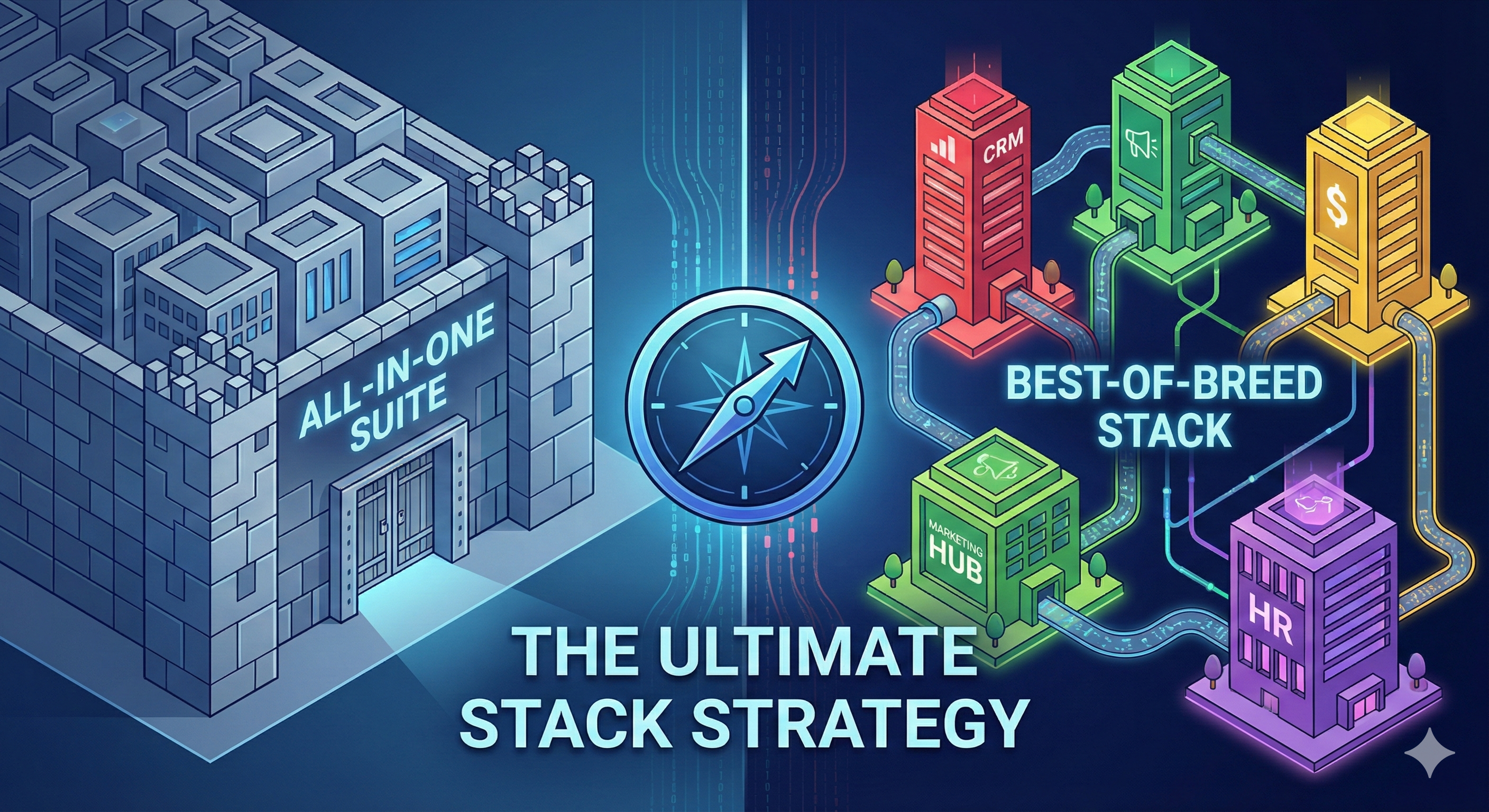
Best-of-breed refers to selecting the best tool in each category—CRM from one vendor, marketing automation from another, ERP from a third, and so on. The idea is that specialized solutions often outperform generalist suites in their specific domain.
Pros:
- Deep functionality in each area
- Faster innovation cycles (smaller companies iterate quickly)
- Flexibility to swap out underperforming tools
Cons:
- Integration overhead (APIs, middleware, data syncing)
- More vendors to manage
- Potential data silos if not carefully orchestrated
All-in-One Suites
All-in-one suites (think Salesforce ecosystem, Microsoft Dynamics 365, Oracle Cloud, SAP S/4HANA) offer multiple modules under a single umbrella—CRM, ERP, HR, marketing, and more.
Pros:
- Pre-built integrations between modules
- Single vendor relationship (simpler contract, support)
- Unified data model (in theory)
Cons:
- "Jack of all trades, master of none" risk
- Vendor lock-in (switching costs are high)
- May pay for modules you don't need
Real-World Considerations
1. Integration Complexity
StackMatch Insight: A best-of-breed stack with 15 tools can easily require 50+ integration points. Before you commit, map out every data flow—CRM to marketing, marketing to analytics, analytics to BI, etc. If your IT team is already stretched thin, that's a red flag.
Conversely, all-in-one suites promise seamless integration, but "out of the box" often means "basic." You may still need custom connectors for edge cases.
2. Total Cost of Ownership (TCO)
Suite vendors love to tout lower TCO because you're buying a bundle. But bundle pricing can obscure the true cost:
- Are you paying for modules you'll never use?
- What's the cost of customization to make "good enough" modules actually work for your processes?
- How much will you spend on training across multiple modules vs. focused training on specialized tools?
StackMatch Insight: Always request itemized pricing. If a vendor can't break down costs by module, that's a negotiation point—and a warning sign.
3. Innovation Speed
Startups and mid-market specialists often ship features faster than enterprise suite vendors. If your industry is evolving rapidly (think fintech, healthtech), a best-of-breed approach may keep you at the cutting edge.
On the other hand, large suite vendors have the resources to invest in AI, security, and compliance at scale. If you're in a heavily regulated industry, the slower pace may actually be a feature—more time for vetting and compliance.
4. Organizational Readiness
This is the factor most buyers underestimate. A best-of-breed stack requires:
- Strong internal integration expertise (or budget for iPaaS tools like Workato, Tray.io, or Boomi)
- Governance processes to manage multiple vendor relationships
- A culture comfortable with change (swapping tools when needed)
An all-in-one suite requires:
- Willingness to adapt processes to fit the software (rather than the other way around)
- Long-term commitment (5+ year horizons are common)
- Executive buy-in for the "platform play"
The Hybrid Approach
Here's a not-so-secret secret: most mature organizations end up with a hybrid stack. They pick a core suite for foundational processes (ERP, HR) and layer in best-of-breed tools where specialized needs demand it.
Example: A mid-market manufacturing company might run SAP for ERP and finance, but use HubSpot for marketing (because their marketing team loves it) and Snowflake for analytics (because their data team needs flexibility).
The key is intentionality. Hybrid stacks that evolve organically become integration nightmares. Hybrid stacks that are planned—with clear data architecture and integration strategy—can deliver the best of both worlds.
Decision Framework: 5 Questions to Ask
Before you choose a strategy, answer these honestly:
-
What's your integration budget and expertise?
- High → Best-of-breed is viable
- Low → Lean toward suites or hire help
-
How specialized are your processes?
- Highly unique → Best-of-breed may be necessary
- Standard → Suites can accommodate
-
What's your vendor management capacity?
- Strong procurement team → BoB is manageable
- Lean team → Fewer vendors = fewer headaches
-
How fast is your industry changing?
- Rapid → BoB keeps you agile
- Stable → Suites provide consistency
-
What's your exit strategy?
- If you need flexibility to pivot, BoB is easier to unwind
- If you're building for long-term scale, suites may lock in stability
Common Pitfalls to Avoid
The "Shiny Object" Trap
Don't pick best-of-breed just because a tool has a slick demo. Evaluate based on your actual requirements, not feature lists you'll never use.
The "One Vendor to Rule Them All" Fallacy
Suite vendors will tell you everything is better when it's integrated. That's marketing. Pressure-test their claims with reference customers who use the same module mix you're considering.
Ignoring the Hidden Costs
- Best-of-breed: middleware, API maintenance, data governance
- Suites: customization, module add-ons, training across platforms
Underestimating Change Management
Switching from a fragmented stack to a suite (or vice versa) is a multi-year journey. Budget for change management, not just software.
The StackMatch Solution
Whether you're evaluating a comprehensive suite or assembling a best-of-breed stack, the real challenge is finding vendors that match your specific requirements—not just feature lists.
StackMatch helps you:
- Define your actual needs with our AI-powered RFQ builder (15 minutes vs. 6 hours)
- Compare vendors objectively across 29 software categories
- Receive competing proposals from qualified vendors who understand your requirements
Instead of spending weeks researching vendors and sitting through sales demos, let vendors compete for your business based on your real needs.
Find Your Perfect Stack Strategy →
Final Thoughts
The best-of-breed vs. all-in-one debate isn't going away. But with the right framework—and honest self-assessment of your organization's capabilities—you can make a decision that serves your business for years to come.
And if you're still on the fence? Start with your most painful process. If a specialized tool can solve it 10x better than a suite module, that's your answer for that category. Build out from there.
Last updated: January 30, 2026